
Missions and Politics

yelling“If you support the general US policy on immigrants, you should cancel your missions trip.” This line was recently posted on Facebook and shared by many people. I don’t agree with the statement, but it brings up an interesting point. How much does our politics interfere with our testimony? How much does our contempt for other political parties or nationalities impact our mission’s goals?

What we spend our time on, what we focus on, what we promote in our lives and social media, says everything about our priorities. The enemy will do everything in his power to distract us from what is essential, to distract us from seeking God first and representing Him well. With today’s non-stop cycle of political news, from an ever more slanted perspective from either side, it’s easy to get distracted from what truly matters.

A while back, a very good friend of mine, a strong Christian and missions-minded person, was spending an inordinate amount of time on social media promoting and sharing his support of the 2nd amendment. We eventually had a conversation where I pointed out that he might be focused more on defending the constitution than actually supporting and defending the Gospel. (He got my point.) The constitution is, in the grand scheme of things, temporary. All things of man are. Eventually, the constitution and the US will fade away and become a footnote in history. The only things that last are the things of God. Too many people are chasing after the shiny object of the temporary, and ignoring the eternal.

Anyone who’s read the news or watched the 24-hour flood of news channels is aware that much of the church is increasingly focused on political issues. The vitriol and fury that so many Christians are demonstrating are, to be honest, embarrassing, and increasingly problematic. “They shall know them by their love.” has been replaced by, “They shall know them by their snarky Facebook posts attacking people they don’t agree with.”

I’m not saying we shouldn’t have an opinion; we have an obligation to stand up for the weak, the defenseless, those in need around us. This is Jesus’ example to us. But how we stand up for others matters a great deal. Jesus was not political; He didn’t pick a side other than hanging out with the rejects of society. He knew there was deep political corruption, He knew it was a broken political system, but He also knew it just didn’t matter. He focused on the individual in front of Him; He focused on what was important.

My team, and many of the groups we host have been helping with the migrant camps in Tijuana. These camps are hosting people from Costa Rica, Haiti, etc. Many of these people left horrifying circumstances for the slim chance of not just a better life, but of survival. A donor to our ministry heard about this and let us know that he would reach out to his church. He was sure they would help with supplies. He was amazed and disappointed when his church gave a very firm, “No.” They would not support “those people.” Think that through, they refused to help migrants because they felt these people should “just go home.” They didn’t like the politics, so it was OK to turn a blind eye. This is counter to everything the Gospel represents. Even if we do see people we don’t agree with as the enemy, we have explicit instruction as to what our response should be. We are called to love our enemy, pray for our enemy, heap blessing on them.

How many of us deserve the blessings and grace that God pours out on us everyday? None of us are worthy, none of us have a right to this grace, but God pours grace in abundance on us anyway.

Jesus taught extensively on this topic. From the good Samaritan to reaching out to lepers, the Gospel leaves no wiggle room as to how we are to serve our fellow human beings. The Gospel does not say only bless those we agree with, only help those who are worthy, only pray for people who are making decisions we agree with. And yet, the church today is increasingly divided into political factions, divided by agendas that have no lasting value. How can we share the Gospel overflowing with grace, acceptance, and love when so much of our lives are bathed in contempt for those around us?

Going back to the line this blog started with: “If you support the general US policy on immigrants, you should cancel your missions trip.” I disagree with that line. Whatever your stance on immigrants is, you should take a missions trip. Spend time studying and understanding the issues from different angles before you go. Go and meet the people that you see on so many news clips. However you feel about their actions or them personally, you are called to love your enemy. By spending time with them, you might find your perceived enemy is actually your fellow child of God, that your enemy is someone that our Heavenly Father cares deeply about.

Any donations to support our mission efforts are greatly apprecated. A dollar or two through the “donate” button would mean a lot. Thanks.

You can help me by sharing this on Facebook or wherever you hang-out online.

Ending Well

lani.jpgAlmost every time I speak in public, I open up by yelling at the group, “You are all going to die!” It frequently gets a nervous laugh or two and then I go on to explain that we are only on this earth a short time, it is so essential to use our time as the precious commodity that it is. Do not waste a moment. The following is the story of a man who used his last few years well.

Jack was a middle-aged man, raising two young children, who had recently moved to a smallish town in Iowa. He had newly been diagnosed with cancer but had not shared his medical condition with anybody in his new community. He was just focusing on his family and beginning the process of diagnosis and treatment.

One day, his next-door neighbor invited him to go on a short-term mission trip to serve at an orphanage in Mexico. The plan was also to help build a home for a needy family. He was not a member of the church, and his first response was, “Well, I don’t play the guitar or anything, but I am good with a hammer.” He was told he would fit in fine. In spite of everything he was going through, he decided to take a chance and tag along with the group. It was a week that would transform his next few years.

As Jack got on the plane with sixty people that he barely knew, all wearing matching t-shirts, he was not sure what to expect. They traveled about two hours south of San Diego to a small town in Mexico where they would be working. The group set up camp and got started with the construction. The team met the family they were serving, and as the team worked, they experienced the joy and bonding that only comes from serving with others in new and challenging circumstances. Jack spent the first few days quietly working alongside his newfound friends.

Midway through the week, during the evening bonfire, Jack decided to take a chance and share of his recent life struggles and his battle with cancer. The response was powerful. This group of people that he had just recently joined came up around him in every sense of the word. The team spent a great deal of time in prayer, seeking miraculous healing. We’ve all heard the phrase, “There are no atheists in foxholes.” There is something about serving alongside others under challenging circumstances that broadens our faith. Serving in missions forges deep relationships that are almost impossible to find unless we are out of our comfort zone.

Over the next few years, while cancer slowly took its toll, Jack continued to return to Baja every time the church came down. Like so many other people, these short-term mission trips became the focal point of his year, a time of joy among struggles, and transformed his life. His social media feed was filled with stories and photos of his time spent serving in Mexico. As Jack’s faith continued to grow stronger, he heard a message from God: “Builder.” This helped Jack understand how his situation was being used for the kingdom.

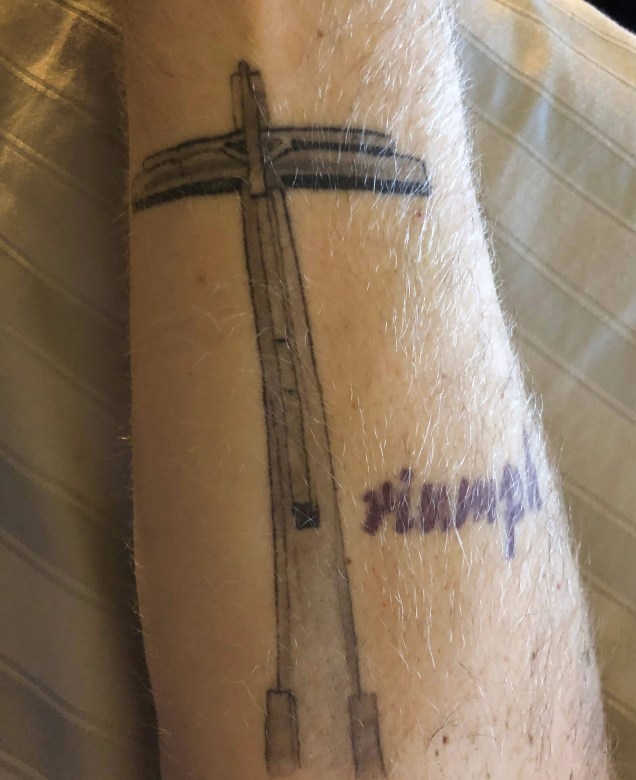
Above the orphanage in Baja where Jack served is a large, very distinct cross. It rises powerfully above a large hill and can be seen from all over the valley. This cross has been the sight of many marriage proposals, recommitments of faith, and other life-changing moments over the years. Jack ultimately had a drawing of the cross tattooed on his arm using the cross as the letter “T” for the word” triumph.” These trips had marked his life in every way possible.

triumph.jpg

As Jack’s life was winding down, one of the leaders came to the hospital in a nearby city to be there for him. As they talked, a nurse walked in that had been on one of these trips before Jack started, and knew all about it. Out of the hundreds of hospital staff who could have walked through the door, this nurse could understand Jack’s experience of faith through missions. They were able to excitedly share of their common experiences in that small town in Mexico.

One of his last requests to the mission leader was, “Make sure when my son is old enough, that he gets to Mexico. I want him to see the place that changed my life.” His other request is that his ashes be spread at the base of the cross overlooking the orphanage and the homes he helped build.

I share this story as an encouragement, an encouragement to end your life well. Jack’s story is one of the thousands of lives that are changed through short term missions and service trips every year. Most people live their lives without thinking too much about the ever approaching end; they make plans to do something “next year” until there are no more years left. Please use the weeks and years you have left in a way that matters. Don’t waste a day.

Jack passed away on May 3rd, 2019, surrounded by family. He is no longer battling cancer or the fights of this earth. He is now dancing in heaven. Close to five hundred people showed up at his memorial on a chilly Tuesday afternoon in Iowa. His ashes will be spread at the orphanage cross, as he requested.

You can help me by sharing this on Facebook or wherever you hang-out online.

If you would like to receive this blog in your e-mail each Monday, please click “follow” above.

What Are Your Motivations?

pexels-photo-1081223I tend to be more of a cynic than I probably should be, but I believe there is no such thing as genuinely pure motives. We are all flawed and imperfect people. These flaws get blended and twisted into any decisions or actions we take. It’s hard to be self-aware when it comes to our motivations, but it’s essential to try and be honest with ourselves about it. I know one gentleman who likes to help needy organizations financially and has the deep pockets to do this. He’s unambiguous that his motivation is all about the photo op, he wants to look good to those around him, and on social media. At least he’s honest about it. (He is not one of our donors.)

If you do a quick google search on motivations, you come up with a wide range of articles with very similar threads. People are listing “The four motivations,” “The ten motivations,” etc. The examples of motivations given are frequently: money, lust, power, fear, popularity, guilt, altruism, generosity, pride, etc.

Almost everyone who participates in short-term missions wants to help, but WHY do they want to help. I once straight up asked a teenage girl who happened to stop by my office why she came on the trip. “My mom forced me to.” I was a little surprised, but I do appreciate honesty. (Fear of mom was the motivation.)

In helping to run a large(ish) non-profit with a range of donors and visiting groups, our team meets a substantial range of individuals. When we meet with group leaders, we hear a lot of the same phrases. “We’re just here to serve.” “What works best for you.” etc. but usually within a few minutes of listening or watching we can begin to see their underlying priorities and motives. Many groups come in with their agenda well before meeting with us or finding out what the real needs are. They have an agenda, and they are NOT going to be moved.

Some group leaders are all about having their team experience a great week. If while having a great week they happen to serve the children in our care, great, but it’s clearly not their priority. They show this by not asking questions, by not thinking about how their activities impact our home, by planning their week around themselves. “I know your kids have homework, but my team REALLY wants to do a craft and VBS with your kids between 2 pm and 4 pm so we can go into town later.” “We know it’s cold outside, and some of your kids are sick, but we really want to push through with the water games we had planned.”

It is very common to have a group, or many individuals in the group, be more focused on the perfect photo op. I’ve seen people pick up a shovel or wheel barrow just to take a photo and then walk away. I’m not exactly saying mission photos get staged all the time but…photos get staged all the time. If you want to see your team’s real motivation, ask them to put their phones away for a few days and don’t take pictures. Rebellion is the usual response. Why do any of us post things online? Is it about encouraging others, or about competing with others to look like we have the perfect life?

Some groups come in assuming they know better than our team how things should be run. They are here to “save us from ourselves.” (pride) I’m aware we have a LOT of room for improvement, and we do learn from others all the time. But when someone comes in less to help, and more to judge or criticize what we do, it gets old fast. We appreciate input or questions but we live with the children in our care, we live in our community, we understand the culture, we have an intimate knowledge of the needs and challenges that go on every day.

We do appreciate the short-term mission teams. Most groups are a huge blessing, and we could use some more! This rambling blog on motivations has the goal of causing self-reflection. Why do we do what we do? This question applies to short-term missions, as well as every other area of our lives. Our motivations have a dramatic impact on every relationship in our lives. It is the lens we use to view and interact with our world.

Motivation can be boiled down to just one question: Who am I serving? Am I serving myself, or am I serving God? If we’re honest with ourselves, this is not an easy question to answer. For almost everyone, it can be a sliding scale. We (I hope) are all trying to serve our Lord more each day, but that gets blended into so many otherworldly motivations. Approval of others, comfort, jealousy, pride, greed, etc. always creep in. I know I question or doubt my true motives all the time.

Indeed, I count everything as loss because of the surpassing worth of knowing Christ Jesus my Lord. For His sake, I have suffered the loss of all things and count them as rubbish, in order that I may gain Christ. Phil 3:8

The paradox is, the purer our motivation, the greater blessing we ultimately receive. The more we try to follow in the pure example of service that Jesus gives, the more our emotional needs are met. As we grow closer to Christ, the worldly motivations fade away. Money, pride, power, etc. really do become worthless compared to the things of God. This is a worthy motivation.

Any donations to support our mission efforts are greatly apprecated. A dollar or two through the “donate” button would mean a lot. Thanks.

You can help me by sharing this on Facebook or wherever you hang-out online.

The Failure of the Individual and Short-Term Missions

pexels-photo-670720At some point, over the last few decades, there has been a subtle yet consistent shift away from the idea of community, to the rise of individual above all else. It’s not working. Addiction and suicide are at an all-time high; in many age groups suicide is the leading cause of death. The church is shrinking at an alarming rate. Depression and loneliness are rampant.

As society shifts from focusing on the community as a whole to focusing on each individual’s desires and achievements, we are losing the very thing that gives us meaning. At almost every turn, technology and shifting attitudes are slowly driving society apart and leading people into their own little cocoons. We need to be connected; we are created to interact with a wide range of people; we are called to sacrifice for others. It’s time to look at how to foster a sense of community again.

Years ago, there was “appointment TV viewing,” the whole family would sit together and watch the same show along with millions of others across the country at the same time. This sounds quaint or primitive now that we can each have our own on-demand screen in front of us and watch exactly what we want when we want it. The downside of on-demand is that, with a few exceptions, that bonding through community viewing doesn’t happen. Outside of the Superbowl or a major news event, there is no common discussion the next day about the latest show that we all watched.

The idea of each of us having our own screens is a small example of how the priority of community is shifting. Few people would argue the fact that America has never been so divided. People have always had opinions, but now that we can watch the news on TV or online catered and designed to reinforce our already deeply held beliefs, we don’t need to listen to any opinion that might call into question where we stand. If we never listen to the other side, they become a bigger and more dangerous enemy in our minds — not a great way to build community.

Subtle changes are taking place all around us. If we want to “eat out” we don’t have to sit with people we don’t know; we can just open the app and have the food brought to our home. We don’t need to go to the mall anymore and interact with real people to buy things; Amazon is just a click away. When was the last time any of us hung out in a book store and browsed around with others with the same interest? When we go to buy groceries, we can self-check to avoid the two minutes of contact with the cashier.

More people are living alone than at any time in the history of America. Fewer people are getting married than at any time in history. Half of all children in America are now born into un-wed situations. Examples of the collapse of community are all around us. Too many people are living in their own little world, and missing out on the interactions and messiness that makes us human.

Even within the ever-shrinking church, many people who are “members” choose to sit at home on Sunday and watch the service online. Interacting with real people is just too much trouble. For the people who are present, as the collection plate is passed in church, many people miss out on the ritual of offering tithes as one body because they’ve already given online automatically.

Although we need a personal relationship with Christ, and God desires that, it’s crucial to recognize the importance of the Church body as a whole and what that means. As we read the Gospels, Jesus spoke to many individuals, but He often spoke about the collective body of believers. The bride of Christ is one, not millions of individual brides. When the apostles asked Jesus how to pray, He gave the Lord’s Prayer as an example. There is not one personal pronoun in the Lord’s prayer. Not one petition for an individual. OUR Father…OUR daily bread…forgive US OUR sins…lead US.  You get the idea. The body of Christ needs each other; we need each other.

So what does this little rant have to do with short-term missions? One of the many benefits of short-term missions is the building of community. You can sit in the same church with the same people for years and never really get to know them. Spend a week traveling in Uganda, or Mexico, or Kenya, and you will get to know them, whether you want to or not. You will see them without makeup and before coffee. You will be forced to sleep in the same room and hear who snores. You will see how each person reacts to difficulties and joys. You will be forced to become a little more transparent. You will learn more about the people in your church, and they will learn more about you, than in ten years of Sundays.

Short-term missions also bring into focus what the Bible teaches about the body of Christ. By traveling out with a team to visit other churches and communities, we have the privilege of living and working with people from wildly different cultures, but with the same Heavenly Father. We get to spend time with our brothers and sisters. We get to experience worship in ways that are beyond what we could ever imagine. We get to bump up against people who are living and walking in faith that sets the bar higher than we might be used to. We have the profound and life-altering experience of living in community with the Church.

Experience community again, make it a point to spend time with people who stretch you. If you can, go on a short-term mission trip. It will change you for the better, your faith will be deeper, your connection to the church will strengthen, and you can help other believers around the world.

You can help me by sharing this on Facebook or wherever you hang-out online.

If you would like to receive this blog in your e-mail each Monday, please click “follow” above.