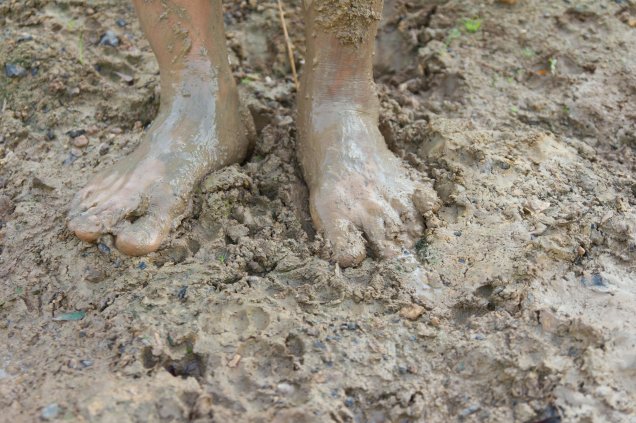
Baptism in Mud

Screen Shot 2018-09-010.jpgI really love baptisms. Every Easter our local church, along with a few other ministries, hold a community baptism. BEST DAY OF THE YEAR. Some people live for Christmas; some people count the days to Thanksgiving. But Easter is the reason our faith exists; it celebrates the day Jesus broke death and rose from the tomb. Combine the profound depth of Easter, with the power of people making the commitment of Baptism, and it doesn’t get better. I look forward to Easter all year.

Although I’m involved in a lot of ministry, the high point of my year is helping the local pastor baptize people. Standing in the water and leaning people back as the water washes over them, marking them as clean before GOD, ushering in that new beginning is monumental. My feeble scribblings do not give justice to this act that has been going on since John the Baptist stood in the River Jordan.

One year, the baptisms didn’t go the way I thought they would. The crowd had gathered at our local lagoon, a wide spot in the local river that even looked biblical that day. The reeds were tall and softly waving in the wind, the sun was bouncing off the grass around the edges of the water. The brown hills framed all this in the background, it felt and looked like John the Baptist himself might wander out to join in the proceedings. The perfect day.

As we got started, our pastor helped one of the other missionaries in the area baptize about six people from another ministry. I stood by the edge assisting people into the soft mud as they walked into the water, afterword I was handing them towels as they came out. I was expectantly waiting for my cue to join our pastor to baptize the people from our church and the children from our orphanage who were taking this step of faith. As the transition was supposed to happen something went wrong, the other missionary stayed out there, and the people from our church started to wander out to be baptized. The transition wasn’t happening for me to go out to help in the water. I soon came to the realization that it was not going to happen.

First I was frustrated, then I was angry. For a few minutes I thought about just wandering out into the water, but I knew it would be awkward. So I just stood in the mud smiling stupidly as I held the hand of each person walking into the lagoon for their life-altering event. I continued to hand them their towels as I was battling my frustration on the inside. “But wait, I’m supposed to be out there!” This was not going as I had envisioned. My Easter was ruined. (I’m a little dense.)

Over the next thirty minutes or so nothing changed on the outside, I was just standing in the mud helping people in and out of the water, but something changed for me on the inside. God knew I needed to spend some time in the mud, and He had planned this day long before I was born. As I watched each person receive this joy into their lives, I started to receive it also. As God was moving through that day, I had to repent of my own enormous pride. Why did I need to be out there in the water? Why did I need to be the person dunking? I told myself it was about the act, but I started to realize it was a little (or a lot) about me, and me being the one doing it. (Once again, I’m a little dense.) I realized my place that day was not the baptizer, I was called to be the one serving the ones being baptized by standing in the mud. I was just there to back up the pastor and help the people being baptized. It changed me.

Many people want to go into ministry. They want to teach, they want to lead worship, they want to be the one up front leading people into a deeper walk with God. There is nothing wrong with that if that is where you’re called. But some people are called to stand in the mud.

Not a lot of people have the dream of someday becoming the sound man. People usually aren’t fighting to handle day-care sign-ins, putting together the bulletin is not an “in demand” position. If you look at what Jesus taught, the “lower” positions in the church should have a long line of people fighting for those jobs. We are called to serve. We are called to do the jobs no one wants, we are called to foot washing. Jesus spoke directly against the leaders of the day exalting in their important positions. It’s easy to think, “Well, those Pharisees were jerks, didn’t they see what they were doing?” How many of us are modern day Pharisees working in ministry for the wrong motivations?

Wherever we stand in the Family of God, it’s important to examine our hearts, our attitudes, our entitlement. We need to daily ask ourselves if we’re being shaped into the example Jesus gave of humble service to others. We need to find and maintain that elusive servant’s heart. Sometimes we need to be baptized in mud.

Orphan Identity: Victim or Victor?

pexels-photo-346796-e1535913334664.jpegWe all have an identity. We are more than just going through life; we are someone. It’s part of our human experience that we identify as more than just a person; we label ourselves as a way of distinguishing ourselves from the many people around us. We might be an athlete, a vegan, or a foodie. We might be a cancer survivor or recovering alcoholic. We’re German American, ginger, or a Buckeyes fan. Even within our faith, we define ourselves: Southern Baptist, Catholic, Methodist, etc. Sometimes we’re born into an identity, sometimes we choose the identity, sometimes society lays an identity on us, but it’s part of who we are. It helps define us. There is a reason the many DNA testing businesses out there are doing so well, people want to know their history, they want to define who they are in some way. “I’m 59% German, 33% Irish, but I have 8% Indian in me.”

For an orphan, identity can be complicated. By definition, a child in an orphanage usually has no history. They frequently don’t know where they came from; they are often brought in with no birthday, no birth certificate, nothing to mark their existence other than they’re alive and breathing. Starting from zero is hard.

A big part of orphan care is helping children shape their identity from scratch. Caregivers tend to focus on the basics: food, shelter, medical care, maybe education. The basics are essential (that’s why they’re called the basics) but there is a deeper level that needs to be addressed once the basics are met. We need to build, or in some cases re-build a child’s identity. To help them see themselves, and identify as, someone of value.

The very word “orphan” brings up all kinds of reactions from people, usually not good. Pity is usually the first reaction, in some cultures contempt: “no one wanted you.” The reaction to being labeled orphan is almost never a positive force. It’s our job to change that.

In many orphan or foster care situations the child embraces the pity reaction, and their identity becomes “victim.” They define themselves by what’s been done to them by their families, and by society. Living in victimhood is a tough road, it means you’re always a little less than others, and it also means you feel entitled to the pity that comes your way. Less is expected of you. When less is expected, that usually results in, something less. If great things are expected, great things can happen.

In some ways, we’re all orphans. We’ve all been hurt, we’ve all been abandoned, and we’ve all been victims of the world. How do we redefine ourselves and build a healthy identity that was intended for us? The first step is to realize we are not orphans, our Heavenly Father has adopted us into the greatest family of all. This is no small thing; it marks us, it sets us apart, it gives us an inheritance beyond words or understanding.

John 14: 18-20 “I will not leave you as orphans; I will come to you. Before long, the world will not see me anymore, but you will see me. Because I live, you also will live. On that day you will realize that I am in my Father, and you are in me, and I am in you.”

To get this across to a young child is a challenge, but if we treat them as the royal children they are, and not as victims, they will begin to see themselves as worthy of love, worthy of belonging. They will take on the identity we place on them, they will see themselves as we see them: as special, precious children in God’s sight and ours.

Shifting identity starts with small details: attentively listening to a child, giving them the attention they desire, having a special cake on their birthday (even if it’s a made-up date). Letting them know they are special goes a long way in moving them from victim to victor.

Another profoundly powerful way to move someone from victimhood is to show them the joy of serving others. Along with the obvious blessing of being part of a family, comes the responsibilities of being part of a family. Jesus came to serve others, and we are asked to do the same. As a child might “help” their parent to fix the car or prepare dinner, being allowed to help in our own feeble way builds a healthy pride, pride of being part of the family, part of something bigger than us. There is something profoundly healing for us as we reach out to help others. By showing someone, even a young child, that they have the power to influence positive change in someone else’s life is profound. It gives them power, and it brings joy, it’s deeply healing. Service moves people from someone to be pitied, to someone representing God. This is a big deal. This creates an identity that is larger than anything the world might place on us.

Our identity defines us. Who are you? And who do you encourage those around you to be? Expect and encourage people to live in the identity of our Heavenly Father. There is no greater label, identity, or way of looking at life.

People Are Irritating

fightPeople frequently ask me, “What’s the biggest challenge of running a large orphanage?” It’s not funding, it’s not dealing with childhood trauma, it’s not even dealing with government bureaucracy. My biggest day-to-day challenge is keeping “grown-ups” from killing each other. Think of any group you’re involved in (work, home fellowship, whatever). Now imagine living with those people seven days a week, twenty-four hours a day. If you’re honest, you might want to kill someone also.

All human beings are flawed, weird creatures with their own baggage, wants, and needs. When people work and live together for long periods of time, all that baggage tends to go on display. You’ve probably heard the saying: “Fish and houseguests go bad after a few days.” Anyone can live together for a while, but over time the quirks and irritating habits come out and grate on each other. Most of the groups we host at our ministry come in for a weekend or maybe a week. When a group books for two weeks we try to have them take a break mid-way through to spend time apart decompressing and to catch their breath. We’ve seen well-intentioned groups self-destruct after having to live together for more than a week. One group gave up and left five days early not speaking to each other. People are complicated.

In our home, we have over 100 children and about 30 adults that all live together. Our large staff is made up of multiple cultures, a wide range of educations and backgrounds, and an even more extensive range of personalities. In spite of the many interpersonal challenges that come up, along with the occasional romances, everyone gets along remarkably well. Not that we spend a lot of time discussing it, but the reason most of our team gets along so well is a sense of humility. A humble servant’s heart helps in any situation or relationship. Listed below are a few thoughts on ministry relationships, in no particular order.

Know that you have your own issues. You’re no picnic. It helps to realize you are as difficult and irritating as everyone you work with. Being self-aware is a challenging and complicated goal. It’s incredibly healthy to hold up the proverbial mirror and take a long look at yourself. “What am I doing to add to the conflict?” There is one person that I need to work with daily who is about a third of my stress. When I feel my blood pressure rise, I’ve started to look inward. Why is this bothering me so much? Does this matter? How am I hurting the situation? Sometimes it is the other person, but it’s pretty hard for any conflict to be entirely one-sided. When you’re frustrated with someone, it’s good to realize; you’re not so great yourself.

Lose the pride. Most people react from one of two places: pride or humility. I know some people who seem to be offended by EVERYTHING, I’m sure you know the type. When someone is always offended, it screams pride. “How dare they do that / ask that / expect that? Don’t they know who I am?” Pride really is the basis for all sin; it’s amazing how it can screw up relationships, workplaces, and lives. People reacting from pride are hard to work with and impossible to correct. You probably thought of at least one person after reading that last sentence, but ask yourself: “How do I respond to correction?” Do I get defensive? Or do I take an honest look at myself and see if changes need to be made? It’s a huge symptom of pride when we can not see our own faults. Throw several prideful people together, and it never works for long. Humility is needed in a ministry, in relationships, and in society, if we are going to survive.

Have grace for others. God has shown wild, abundant grace to us, way more than we could ever deserve, we need to have that same abundant grace for those around us. We need to show that grace to others, pour grace over others, and see them through our Father’s eyes. It’s easy to focus on what someone else is doing wrong; it’s harder to look at the person and see why. Everyone has been hurt; everyone makes questionable decisions, everyone is looking at life through their own warped lens and history. We need to “walk a mile in their shoes” and try to understand them as the valued individuals that God sees. When we see people with God’s eyes, they appear very different. When we truly hurt for someone, it’s hard to be hurt by someone.

When we’re looking for new staff, the most important thing we look for is a servant’s heart. Skills can be taught to anyone willing to learn, but a servant’s heart is essential for living in a community. A humble servant’s heart means someone has an understanding of what it means to walk in Christ’s example. Christ was a humble servant, and people were (and are) drawn to that. Christ was honest, He was OK with calling out sinful behavior, but it was always to teach, never to yell “gotcha.” He wanted what was best for all those around Him.

People are irritating, ourselves included. By walking in Christ’s example and seeing people as He sees them, living and working with others shifts into what God desires for us. We can live and work with others in peace, if it’s not about us.

If you liked this, please share on Facebook or wherever you want to. thanks

Embrace the Storms

treeThis last week at our ministry we had to have some incredibly difficult meetings. One of our larger donors is having their own financial issues, and it’s trickled down to us, cutting our ministry income dramatically. The cuts we’ve had to make are difficult and painful, but they are cuts that need to be made for the ministry to survive and move forward. I know the pain we’re going through is ultimately a good thing. The idea that this is a positive season took some convincing for the other people in the meetings, but we know God will use this.

It’s easy to spout the platitudes that God can use all things, that all things work together for good, etc. It’s very different when you’re going through trials, attacks, and challenges many people never anticipate. It helps to look through the lens of history to see trials and tribulations that are not only survived, but cause a ministry or individual to strengthen and to flourish. We do need the storms in our lives to toughen us, to grow us, and to cause us to depend on God once again.

Several years ago there was an experiment in Arizona where scientists created a biosphere (not Bio-Dome, the horrible 90s movie with Pauly Shore, but the same idea). A biosphere is a complete ecosystem within an enclosed space. It’s helpful in research due to the ability of the people running it to control all the variables. Scientists built a HUGE biosphere with everything needed for the plants, animals, etc. to survive. After a while something started to happen, the trees were growing well but had very little bark. Soon all the trees began to topple over, one by one, under their own weight. No one could figure out why. They had good soil, the right amount of water, the temperature was right, there was no disease or pests, but the trees were dying anyway. It took a while, but they finally figured it out. There was no wind. A typical tree from a young age is buffeted by breezes, winds, and storms. A tree bends back and forth, sometimes dramatically, sometimes subtly, but a tree is almost always in motion. The action of the wind makes the tree stronger; it causes bark to grow to protect the tree, it causes roots to dig down deep to build a solid foundation. The daily struggles against and with the wind prepare the tree for the storms that inevitably come. Without wind, a tree withers and dies.

Many years ago, our home cared for several young men with spinal cord injuries. One young man in his late teens was paraplegic, but it never got him down. Carlos was very bright, friendly, and had become fully bilingual while in our home. Over time the other children in our care, the staff, and many of the visitors came to love Carlos and the way he carried himself. He was a powerful example and an encouragement to everyone he encountered. One day, while he was preparing to leave for two weeks of treatments at a medical center in California, he made a point to say a real “goodbye” to a lot of the kids and staff – I think he somehow knew he would not be back. In route to the hospital, he had an adverse reaction to some prescription meds and passed away. Carlos’s death was obviously a very difficult time for our large family. We spent a great deal of time with the kids in our care to help them through the grieving process, while we were also grieving.

A few months after Carlos passed we were talking about the experience and what came of it. Carlos was now waking in heaven, he died too soon in our eyes, but there is nothing we can do. It sounds odd, but children in an orphanage never deal with actual death. They aren’t around grandparents who die. Most of the children in our care, if they remember parents at all, they remember them as alive and younger – most of our kids are with us do to abandonment or abuse, very few from the death of parents. Death just doesn’t come up too often in an orphanage. Carlos was the first death in our big family in over ten years. Along with many other lessons learned from the passing of Carlos, it opened the doors to some great conversations with our many children about how fragile life is, about the need to use the time we do have here well, about appreciating those around us while we can. It also opened up the conversation about preparing for eternity into sharp focus. Don’t get me wrong, Carlos’s death was tragic, but it caused huge growth in our children, our staff, and the ministry as a whole. Would I want to go through that again? Of course not, but it did bring many hidden blessing only seen in hindsight.

No one goes looking for trials and hardship. No one enjoys suffering loss or being hurt by others. We don’t need to look for difficult times because life tends to bring them to our door. Difficult times are part of the fallen world we live in. It’s so important to realize that as believers, our Heavenly Father is more powerful than any trials or hardships that come into our lives. He can take the pain and cause growth; He can use the winds of this world to make us stronger, to build us up to be mighty oaks against the powerful storms that, with time, come into everyone’s life.

Embrace the storms in your life, dare to spread your arms and catch the brunt of the winds that blow against you. God will not only keep you upright; He’ll use it to make you stronger if you allow Him.

Please share on Facebook or wherever you hang out online.